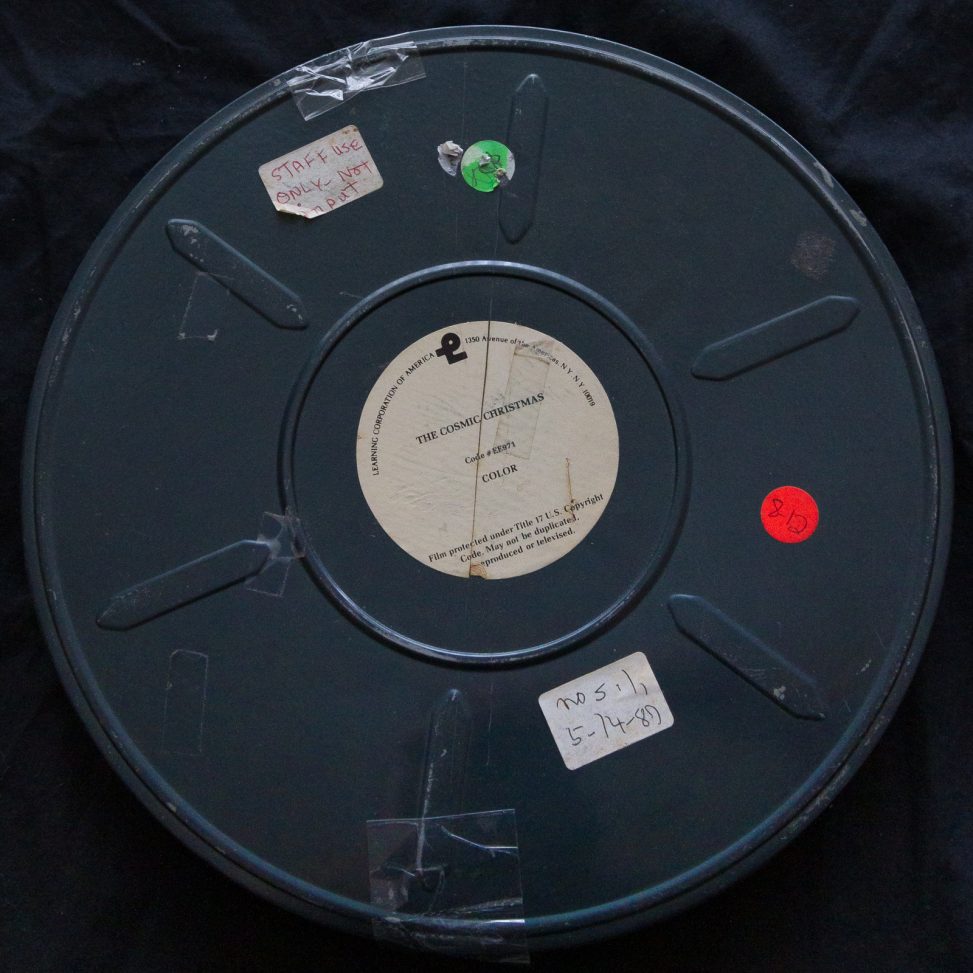
A canister containing a 16mm print of ‘A Cosmic Christmas‘, from a school that used it as a teaching tool in the classroom.
Here is an old print of A Cosmic Christmas, faded largely to red hues I’m afraid, but not surprising for a fifty year old print that was likely just left in a school all that time. It does however contain some interesting information in the form of a film guide for teachers and students.
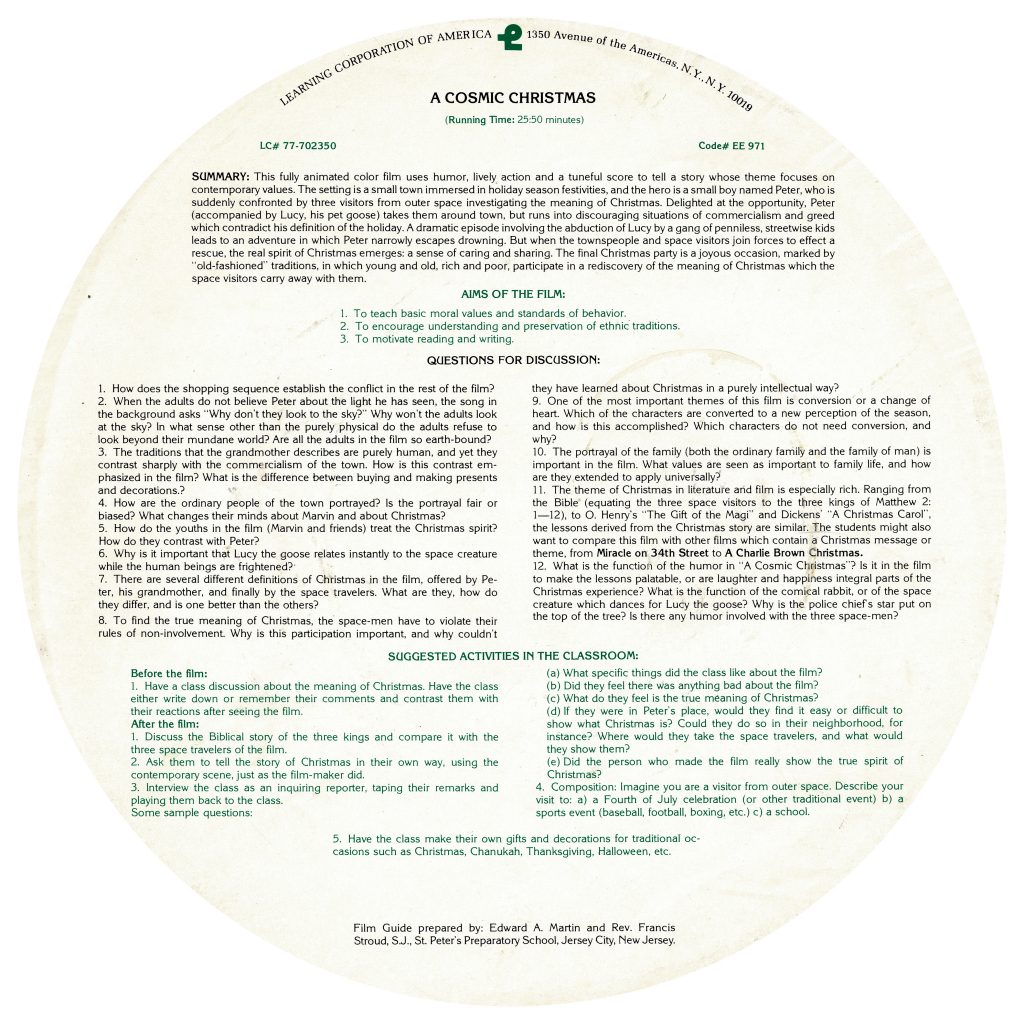
At some point I’ll probably finding myself going through it frame by frame, seeing if there’s any difference in the edit. At 25:50, it’s 9 seconds longer than the most common version (approximately 2:20 seconds longer than the VHS), but I’m sure that could be down to just end credits or a longer lead into the film being counted. Not expecting a big difference, but I’ll have to check eventually!
Text of Cosmic Christmas Film:
Learning corporation of America • 1350 Avenue of the Americas, N.Y., N.Y. 10019
A COSMIC CHRISTMAS
(Running Time: 25:50 minutes)
LC # 77-702350
Code#EE 971
SUMMARY: This fully animated color film uses humour, lively action and a tuneful score to tell a story whose theme focuses on contemporary values. The setting is a small town immerse in holiday season festivity’s, and the hero is a small boy named Peter, who is suddenly confronted by three visitors from outer space investigating the meaning of Christmas. Delighted at the opportunity, Peter (accompanied by Lucy, his pet goose) takes them around town, but runs into discouraging situations of commercialism and greed which contradict his definition of the holiday. A dramatic episode involving the abduction of Lucy by a gang of penniless, streetwise kids leads to an adventure in which Peter narrowly escapes drowning. But when the townspeople and space visitors join forces to effect a rescue, the real spirit of Christmas emerges: a sense of caring and sharing. The final Christmas party is a joyous occasion, marked by “old-fashioned” traditions, in which young and old, rich and poor, participate in a rediscovery of the meaning of Christmas which the space visitors carry away with them.
AIMS OF THE FILM:
- To teach the basic moral values and standards of behavior.
- To encourage understanding and preservation of ethnic traditions.
- To motivate reading and writing.
QUESTIONS FOR DISCUSSION:
- How does the shopping sequence establish the conflict in the rest of the film?
- When the adults do not believe Peter about the light he has seen, the song in the background asks “Why don’t they look to the sky?” Why won’t the adults look at the sky? In what sense other than the purely physical do the adults refuse to look beyond their mundane world? Are all the adults in the film so earth-bound?
- The traditions that the grandmother describes are purely human, and yet they contrast sharply with the commercialism of the town. How is this contrast emphasized in the film? What is the difference between buying and making presents and decorations?
- How are the ordinary people of the town portrayed? Is the portrayal fair or biased? What changes their minds about Marvin and about Christmas?
- How do the youths in the film (Marvin and friends) treat the Christmas spirit? How do they contrast with Peter?
- Why is it important that Lucy the goose relates instantly to the space creature while the human beings are frightened?
- There are several different definitions of Christmas in the film, offered by Peter, his grandmother, and finally by the space travellers. What are they, how do they differ, and is one better than the others?
- To find the true meaning of Christmas, the space-men have to violate their rules of non-involvement. Why is this participation important, and why couldn’t they have learned about Christmas in a purely intellectual way?
- One of the most important themes of this film is conversion or a change of heart. Which of the characters are converted to a new perception of the season, and how is this accomplished? Which characters do not need conversions, and why?
- The portrayal of the family (both the ordinary family and the family of man) is important in the film. What values are seen as important to family life, and how are they extended to apply universally?
- The theme of Christmas in literature and film is especially rich. Ranging from the Bible (equating the three space visitors to the three kings of Matthew 2:1–12), to O. Henry’s “The Gift of the Magi” and Dickens’ “A Christmas Carol”, the lessons derived from the Christmas story are similar. The students might also want to compare this film with other films which contain a Christmas message or theme, from Miracle on 34th Street to A Charlie Brown Christmas.
- What is the function of the humor in “A Cosmic Christmas”? Is it in the film to make the lessons palatable, or are laughter and happiness integral parts of the Christmas experience? What is the function of the comical rabbit, or of the space creature which dances for Lucy the goose? Why is the police chief’s star put on the top of the tree? Is there any humor involved with the three space-men?
SUGGESTED ACTIVITIES IN THE CLASSROOM:
Before the film:
1. Have a class discussion about the meaning of Christmas. Have the class either write down or remember their comments and contrast them with their reactions after seeing the film.
After the film:
1. Discuss the Biblical story of the three kings and compare it with the three space travellers of the film.
2. Ask them to tell the story of Christmas in their own way, using the contemporary scene, just as the film-maker did.
- Interview the class as an inquiring reporter, taping their remarks and playing them back to the class.
Some sample questions:
(a) What specific things did the class like about the film?
(b) Did they feel there was anything bad about the film?
(c) What do they feel is the true meaning of Christmas?
(d) If they were in Peter’s place, would they find it easy or difficult to show what Christmas is? Could they do so in their neighbourhood, for instance? Where would they take the space travellers, and what would they show them?
(e) Did the person who made the film really show the true spirit of Christmas? - Composition: Imagine you are a visitor from outer space. Describe your visit to: a) a Fourth of July celebration (or other traditional event) b) a sports event (baseball, football, boxing, etc.) c) a school.
- Have the class make their own gifts and decorations for traditional occasions such as Christmas, Chanukah, Thanksgiving, Halloween, etc.
Film Guide prepared by: Edward A. Martin and Rev. Francis Stroud, S.J., St. Peter’s Preparatory School, Jersey City, New Jersey.
Note: The label on the canister mislabels the film as ‘The Cosmic Christmas‘.
Leave a Reply