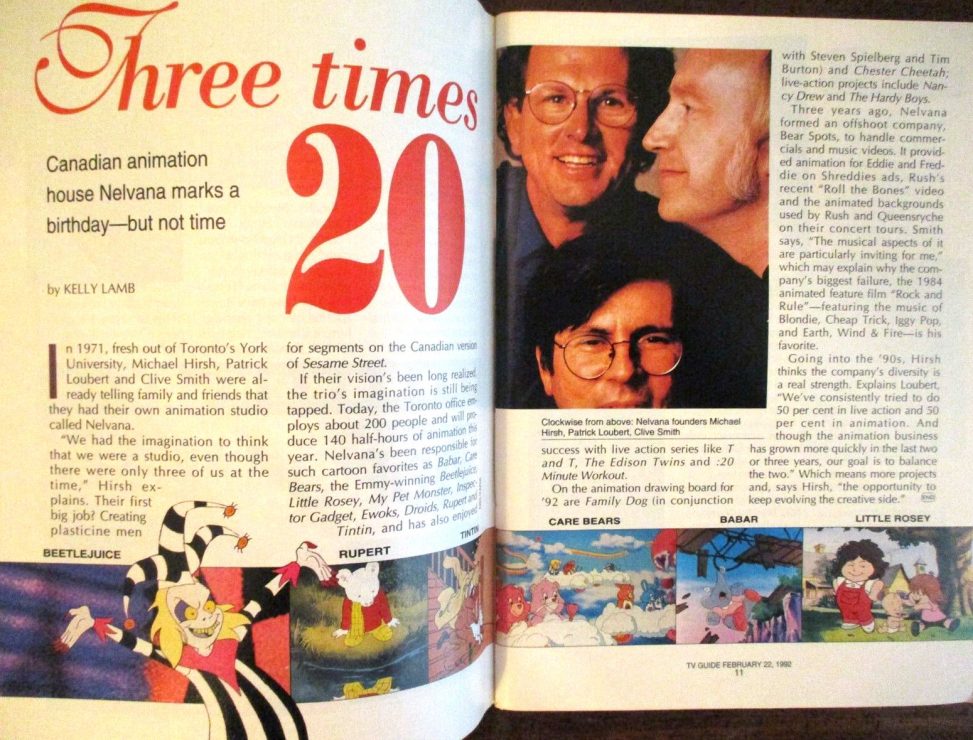
A TV Guide article from February 22, 1992 to make Nelvana’s 20th Birthday.
Text:
Three Times 20
Canadian animation house Nelvana marks a birthday – but not time.
by Kelly Lamb
In 1971, fresh out of Toronto’s York University, Michael Hirsh, Patrick Loubert and Clive Smith were already telling family and friends that they had their own animation studio called Nelvana.
“We had the imagination to think that we were a studio, even though there were only three of us at the time,” Hirsh explains. Their first big job? Creating plasticine men for segments on the Canadian version of Sesame Street.
If their vision’s been long realized, the trio’s imagination is still being tapped. Today, the Toronto office employs about 200 people and will produce 140 half-hours of animation this year. Nelvana’s been responsible for such cartoon favorites as Babar, Care Bears, the Emmy-winning Beetlejuice, Little Rosey, My Pet Monster, Inspector Gadget, Ewoks, Droids, Rupert and Tintin, and has also enjoyed success with live action series like T and T, The Edison Twins and :20 Minute Workout.
On the animation drawing board for ’92 are Family Dog (in conjunction with Steven Spielberg and Tim Burton) and Chester Cheetah; live-action projects include Nancy Drew and The Hardy Boys.
Three years ago, Nelvana formed an offshoot company, Bear Spots, to handle commercials and music videos. It provided animation for Eddie and Freddie on Shreddies ads, Rush’s recent “Roll the Bones” video and the animated backgrounds used by Rush and Queensryche on their concert tours. Smith says, “The musical aspects of it are particularly inviting to me,” which may explain why the company’s biggest failure, the 1984 animated feature film “Rock and Rule” – featuring the music of Blondie, Cheap Trick, Iggy Pop, and Earth, Wind & Fire – is his favorite.
Going into the ’90s, Hirsh thinks the company’s diversity is a real strength. Explains Loubert, “We’ve consistently tried to do 50 per cent in live action and 50 per cent in animation. And though the animation business has grown more quickly in the last two or three years, our goal is to balance the two.” Which means more projects and, says Hirsh, “the opportunity to keep evolving the creative side.”
TV Guide – February 22, 1992.
Leave a Reply